I work around open networks, exploring things like the Beckn Protocol to see how different systems can interact without a single platform controlling everything. That’s actually how I first came across the term “Finternet.”
I heard it again recently at the Global Fintech Fest, when Nandan Nilekani spoke about tokenization, AI agents, and building a “financial internet.” At first, I didn’t fully understand what it meant. But the more I read, the simpler the idea started to feel.
The problem Finternet is trying to solve
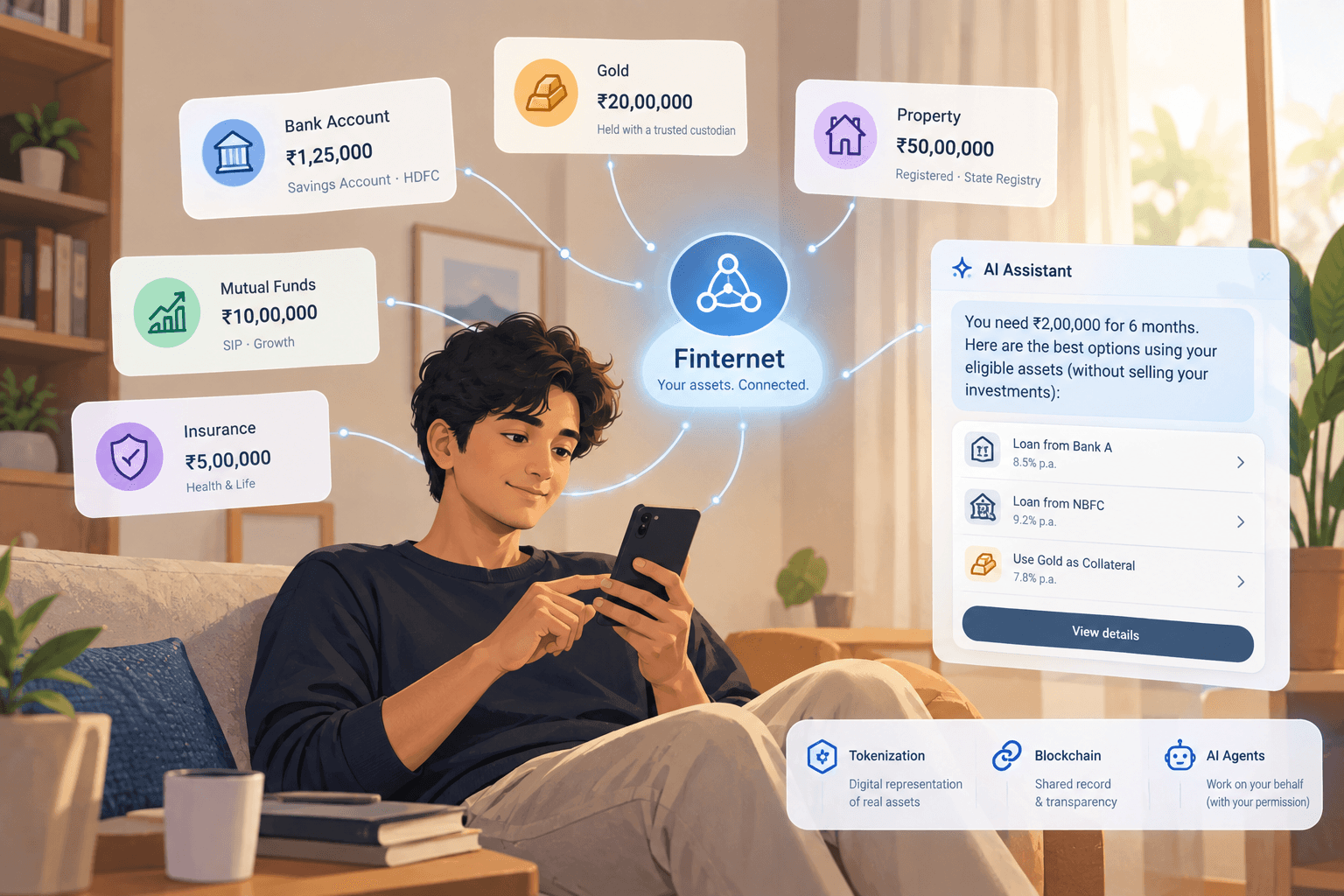
Think about the things you own. You probably have some money in a bank account, mutual funds with an investment app, a bit of gold at home, and maybe a house or land registered with the local authority.
All of these are your assets, but they live in completely separate worlds.
If you ever need a loan against them, the headache begins. You have to run around collecting documents, prove you actually own each asset, and wait for different people to verify them. You know you own all of it, but your bank has no way of talking to the land registry or your gold locker.
Your assets are real, but our financial systems are isolated islands. This is the exact friction Finternet wants to fix.
Think about UPI (and the cheque era)
The easiest way to understand what Finternet is trying to do is to look at how we used to move money.
Before UPI, if you wanted to transfer money, you had to write a physical cheque. You’d go to the bank, wait in line, and hand it over to someone at the counter. That person had to open up their system, manually verify that you actually had the money in your account, stamp the paper, and process it. It often took days just to clear.
UPI changed that completely. It didn’t replace banks; it just connected them using a shared set of rules. Today, you scan a QR code, the systems verify everything behind the scenes in milliseconds, and the money moves instantly.
Right now, our financial assets are stuck in that old “cheque” era. If you want to use your gold, shares, or property, someone has to manually check papers and make phone calls between disconnected offices.
Finternet wants to do for all our assets what UPI did for cash: connect the systems so they can talk to each other and verify ownership instantly.
What is a token, really?
To make this work across different systems, assets need to be “tokenized.”
When people hear the word token, they usually think of cryptocurrency or tokens in AI. But here, the idea is much simpler. Think of a ₹500 note.
A currency note is basically a physical token. It carries its value, its unique serial number, and the official promise of the RBI, all printed on that single piece of paper. When you hand that note to a shopkeeper, they don’t have to call the central bank to verify your balance. Everything needed to trust and accept the note travels right there with it.
Finternet wants to do the exact same thing digitally. Instead of your asset’s details being scattered across multiple databases and paper files, a digital token bundles the asset and all its verified information into one neat, portable package.
This isn’t just theoretical there are already pilots exploring this on the ground. For instance, projects are testing how to tokenize a dairy farmer’s cow or a warehouse receipt for stored wheat. Instead of a farmer waiting weeks for someone to inspect physical records, the lender can instantly read the verified token and approve credit on the spot.
The physical world is still physical
Whenever people talk about tokens and shared records, blockchain usually comes up. But Finternet isn’t about forcing everything onto one particular blockchain. It’s simply about having a reliable, shared history of events so everyone knows how an asset reached its current state.
That sounds great inside a computer, but we run into an obvious challenge: the physical world is still physical.
Suppose you deposit ₹2 lakh worth of gold in a vault and get a digital token for it. Later, you withdraw that gold, take it home, and sell it to someone for cash. The digital system records that the gold left the vault, but it has no way of knowing what you did with it afterwards.
It’s just like UPI. If I send you ₹10,000 through an app, there’s an instant digital trail. But if I withdraw that ₹10,000 from an ATM and hand you the cash, UPI has no clue where the money went.
A digital system can only track what happens inside its own network. That’s why creating a digital token is only half the work. You still need trusted institutions, custodians, and clear legal rules to make sure the digital token always matches the real-world reality.
And then there are AI agents
This is an area where things get really interesting. When financial services and assets speak a common digital language, software finally has structured data it can actually work with.
There are countless applications where AI can step in to cut down repetitive back-and-forth — whether it’s helping a user discover eligible services or helping a bank automatically parse and verify incoming asset data. While humans will still need to verify critical steps and make the final decisions, the sheer amount of manual legwork reduces drastically.
It’s still very early, and AI agents don’t define what Finternet is. But having a shared, open financial infrastructure is what gives them a reliable foundation to actually be useful.
Why I find this interesting
For me, Finternet is interesting because it doesn’t feel like just another app or a trendy feature. It feels like an attempt to build common public infrastructure for finance.
The internet made information universal. UPI made moving money instant. Connecting all our financial assets and services through shared, open standards seems like the natural next evolution.
I’m still learning about this space and tracking how it evolves, so if you think I missed something or got anything wrong, I’d love to hear your thoughts!