If you scroll through tech Twitter, LinkedIn, YouTube, or Medium right now, you’ll find hundreds of posts breaking down DeepSeek Harness: what the architecture looks like, how to spin up the local web UI, and what “everything is a plugin” means on paper.
Honestly, I don’t think it makes much sense to add yet another tutorial just rehashing the same features. I wanted to take a completely different approach.
If you read the initial wave of hype, you’d think DeepSeek Harness is a magic wand that instantly makes every other coding assistant obsolete. To see if that was true, I put it to the test. I gave the exact same prompt to build an app to both Claude Code and DeepSeek Harness.
Honestly? Claude Code won.
Claude’s output was significantly more polished, cohesive, and required much less hand-holding. DeepSeek Harness felt a bit rougher around the edges. If I were just looking for the easiest, most frictionless tool to use today, I would stick with Claude.
But judging DeepSeek Harness strictly on out-of-the-box polish completely misses the point of what it actually is.
We are watching the AI agent space split into two distinct engineering philosophies — and it looks surprisingly similar to the smartphone wars all over again.
The Apple Approach: Claude Code and Codex
Why do Claude Code and OpenAI’s Codex feel so smooth? Because they are the Apple / iOS of the AI world.
Anthropic and OpenAI control the entire stack. They build the model, write the system prompts, define the tools, manage the agent loop, and build the interface — the harness.
Because everything is designed by one company for its own models, they have a unique advantage: they understand how those models behave and can tune the surrounding system accordingly.
It’s almost like knowing that Sonnet responds better to a certain way of being instructed: “Hey sweetie, you’re Sonnet, and here’s how I want you to work.” Anthropic can bake that kind of model-specific knowledge directly into Claude Code. A third-party harness may not know those little tricks.
It is a closed, proprietary ecosystem optimized for maximum polish. Developers are willing to pay the premium because the results are fantastic.
But that polish comes at a cost — literally.
The Android Approach: DeepSeek Harness and Pi.dev
DeepSeek Harness is the Android of AI agents. It is an open, highly customizable, plugin-driven infrastructure.
DeepSeek’s core philosophy is “Everything is a plugin.” Built on a meta-framework called Cordis, the harness allows you to swap out almost everything around the model — from tools and permissions to workflows and other parts of the agent environment.
And this is where the Android analogy becomes even more relevant: with more freedom comes more responsibility.
DeepSeek Harness is still in developer preview, so if you decide to experiment with it, I would be careful about the plugins you install. Just because a plugin is available in the ecosystem doesn’t automatically mean you should trust it. Developers should check where a plugin comes from, what it actually does, and what permissions or access it requires before adding it to their development environment.
This is especially important for anything that could access your source code, filesystem, credentials, API keys, or other sensitive resources. Open ecosystems are powerful precisely because developers can extend them, but that also means you need to treat third-party plugins with the same caution you would give any other third-party code.
If this sounds familiar, it is because tools like Pi have been exploring a similar philosophy. Pi is a fantastic, highly customizable agent harness that keeps things intentionally minimal, primarily through a Terminal User Interface (TUI).
DeepSeek Harness takes a similar open and customizable philosophy but wraps it in a full Web UI with features such as visual trajectory debugging.
But there is a trade-off.
Because it is so open, it doesn’t have the same tightly coupled polish you get from something like Claude Code.
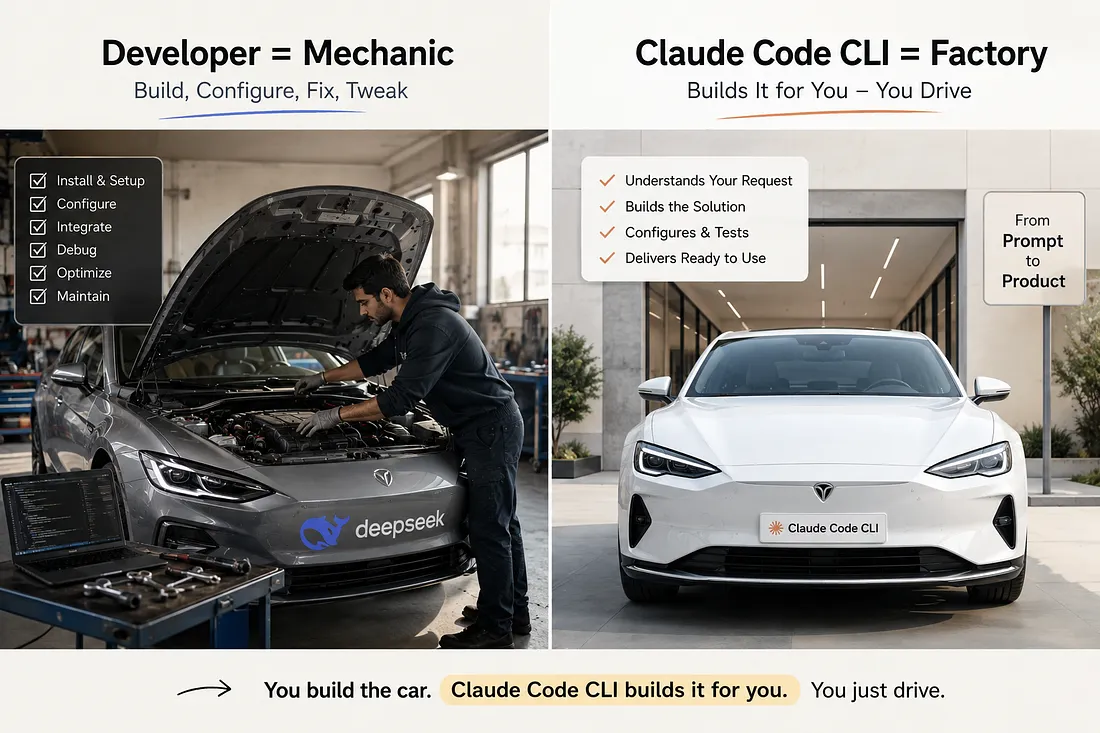
It is a factory where you have to set up the assembly line.
The New Developer Superpower: Finding the “Sweet Spot”
This brings us to a massive shift in how we build software. We hear it all the time: “It’s not the model, it’s the prompt.” But as agents get more complex, the better question might be: “What if it’s the harness?”
Take a brilliant frontier model and put it in a terrible harness — with poor tools, bad context management, and no verification — and you’ll waste a lot of its potential. Think of the model as the engine that came from the factory. The harness is the car you build around it — the transmission, controls, dashboard, and everything that helps you actually use that engine. You might start with the same engine as everyone else, but with the right setup and tuning for your particular use case, you can make it perform much better for what you actually need.
The model is the engine. The harness is how you drive it.
This could become a new superpower for software developers. Instead of only asking “Which model is the best?”, developers may increasingly ask: “What is the best way to use this model?” And that’s where things get interesting. We could see developers building and sharing custom tools, plugins, prompts, context strategies, and workflow loops designed to squeeze every bit of performance out of the models they use.
The Verdict: Paying for Polish vs. Building for Cost
Today, a lot of developers will still prefer Claude Code. If your goal is simply to get a polished result right now and you don’t mind the token bill, the “Apple” approach wins.
But as models like Fable and other powerful frontier models become more expensive, I think companies will increasingly care about a different metric:
How much does it actually cost to complete the task?
That is where the “Android” approach gets interesting.
Instead of always reaching for the most powerful model, developers can experiment with cheaper models, better tools, smarter context management, and custom workflow loops to find the sweet spot between cost, speed, and quality.
The real skill may become finding the gaps in a model and designing the harness around them.
Not just asking:
“Which model is smartest?”
But:
“What is the cheapest way to get the same job done well?”
DeepSeek Harness and other open ecosystems are still early and require more upfront configuration. But as the community builds better plugins, tools, and workflows, we could see developers being rewarded not just for writing good code, but for finding the most cost-efficient way to make AI get the job done.
Personally, I would still pick Claude Code for my day-to-day work and anything I’m building for paying customers. The results and polish are hard to ignore.
But experimenting with these open harnesses is incredibly exciting.
If we can find that sweet spot where a cheaper model delivers almost the same result at a fraction of the cost, that’s a game worth playing.
The future of software development may not just be about building with smarter models. It may be about finding the smartest way to use them.